We have calculated over 200 years of combined work experience in the field between all service providers in the collective
There are moments when life finally slows down, the conflict ends, the deadline passes, or the crisis is resolved — yet your body still feels anxious, tense, exhausted, irritable, or emotionally overwhelmed.
Many people assume this means they are “bad at coping,” too sensitive, or unable to relax. But from a somatic and nervous system perspective, something else may be happening:
Your body may not have completed the stress cycle.
Understanding how stress lives in the body — and how to help the nervous system move through it — can profoundly change the way we relate to anxiety, burnout, trauma, guilt, overwhelm, and emotional exhaustion.
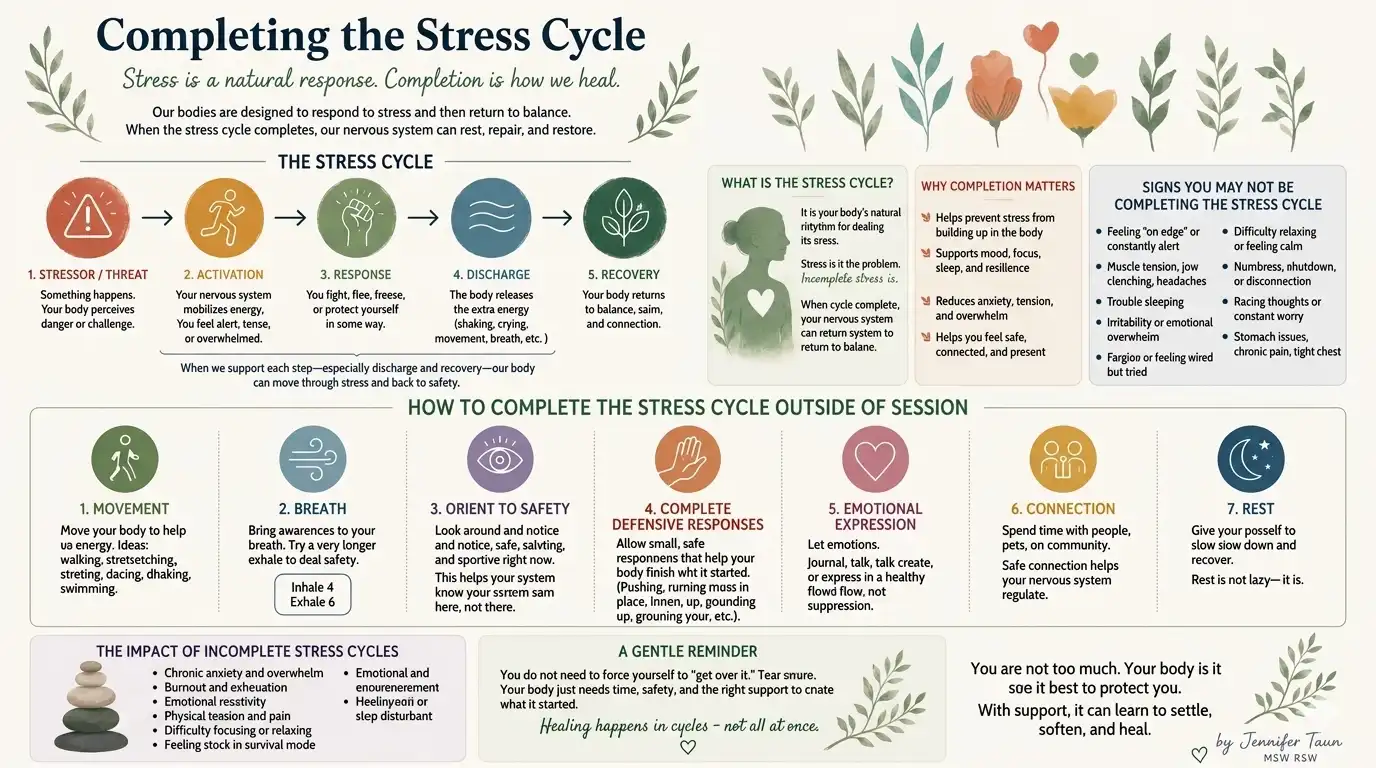
The stress cycle is the body’s natural physiological response to stress, threat, challenge, or activation.
When the nervous system detects danger (real or perceived), the body mobilizes energy to help us survive. This can look like:
This activation is not the problem. It is actually the body doing exactly what it was designed to do.
The issue arises when the body never gets the signal that the stressor is over.
In Somatic Experiencing and other body-based trauma therapies, we understand that stress is not only a mental experience — it is a physiological one. The nervous system needs support to discharge, process, and reorganize after activation.
Without completion, the body can remain stuck in survival mode long after the event has ended.
Many people try to “think” their way out of stress.
They tell themselves:
But stress is not only cognitive. It is embodied.
You cannot always reason your nervous system into safety.
When stress remains incomplete, the body may continue behaving as though danger is still present. Over time, this can contribute to:
Many people are functioning day-to-day while carrying unresolved activation in their nervous systems without even realizing it.
Sometimes people assume stress only “counts” if it was severe trauma. But the nervous system responds to many forms of overwhelm, including chronic stress, emotional conflict, caregiving, work pressure, grief, relational tension, or ongoing uncertainty.
You may not be completing stress cycles if you notice:
Often people intellectually know they are safe, but their bodies do not yet feel safe.
That distinction is incredibly important.
In Somatic Experiencing, we understand that animals naturally discharge survival energy after stress. You may have seen a dog shake after a frightening moment or a deer tremble after escaping danger.
Humans are designed similarly.
But many of us interrupt these natural processes through:
Instead of allowing activation to move through, we override it.
Over time, unfinished stress accumulates in the nervous system.
Completing the stress cycle does not mean “getting rid” of emotions. It means helping the body move through activation toward regulation and safety.
Completing stress is less about forcing calm and more about helping the nervous system experience enough safety, movement, connection, and discharge to settle naturally.
Below are practices that can help outside of therapy sessions.
Stress creates mobilized energy in the body. Gentle movement helps that energy move through instead of becoming trapped.
Helpful forms of movement may include:
The goal is not intense fitness or punishment. The goal is nervous system completion.
Sometimes even five minutes of intentional movement can help the body shift.
When stressed, breathing often becomes shallow or constricted.
Rather than forcing deep breathing, begin with noticing:
Longer exhales can help communicate safety to the nervous system.
Try:
But remember: if breathwork feels overwhelming, stop. Safety and pacing matter.
Trauma and stress narrow our attention toward threat.
Orienting is a somatic practice that helps the nervous system reconnect with the present environment.
Try slowly looking around the room and noticing:
This helps the body recognize:
“I am here right now.”
“The danger is not happening in this moment.”
Sometimes the body holds incomplete survival impulses.
For example:
Gentle somatic work may involve safely exploring these impulses through small movements.
Examples:
This can help the nervous system experience completion where it previously felt stuck.
Stress often remains trapped when emotions are suppressed.
Healthy expression might include:
The goal is not emotional flooding. It is allowing emotions to move instead of remain frozen inside.
Humans regulate through safe connection.
Being with someone who feels calm, attuned, and supportive can help the nervous system settle in ways we often cannot achieve alone.
This may include:
Healing is rarely meant to happen in isolation.
Many people only allow themselves rest once they are completely depleted.
But the nervous system needs regular recovery — not just collapse after burnout.
Intentional rest may include:
Rest is not laziness. It is biological regulation.
For some people, slowing down feels unsafe.
When survival mode has become familiar, stillness may initially increase anxiety or discomfort. This does not mean you are failing.
It simply means your nervous system may need gradual, compassionate pacing.
Healing from chronic stress or trauma is not about forcing yourself to relax. It is about helping the body learn — often slowly — that it no longer has to remain in survival mode all the time.
You Do Not Need to “Earn” Regulation
One of the most painful beliefs many people carry is:
“I can rest once everything is done.”
“I can feel okay once I fix everything.”
“I should be able to handle this.”
But nervous systems are not machines.
Stress completion is not weakness, avoidance, or indulgence. It is part of how humans are biologically designed to recover, adapt, and heal.
The body is not working against you.
Often, it is asking for completion, safety, and care in the only language it knows — sensation, emotion, activation, and rest.
And when we begin listening to the body with compassion instead of judgment, regulation becomes much more possible.
by Jennifer Taun MSW RSW

| Cookie | Duration | Description |
|---|---|---|
| cookielawinfo-checkbox-analytics | 11 months | This cookie is set by GDPR Cookie Consent plugin. The cookie is used to store the user consent for the cookies in the category "Analytics". |
| cookielawinfo-checkbox-functional | 11 months | The cookie is set by GDPR cookie consent to record the user consent for the cookies in the category "Functional". |
| cookielawinfo-checkbox-necessary | 11 months | This cookie is set by GDPR Cookie Consent plugin. The cookies is used to store the user consent for the cookies in the category "Necessary". |
| cookielawinfo-checkbox-others | 11 months | This cookie is set by GDPR Cookie Consent plugin. The cookie is used to store the user consent for the cookies in the category "Other. |
| cookielawinfo-checkbox-performance | 11 months | This cookie is set by GDPR Cookie Consent plugin. The cookie is used to store the user consent for the cookies in the category "Performance". |
| viewed_cookie_policy | 11 months | The cookie is set by the GDPR Cookie Consent plugin and is used to store whether or not user has consented to the use of cookies. It does not store any personal data. |